by Edison Irabor, Senior Policy Reporter
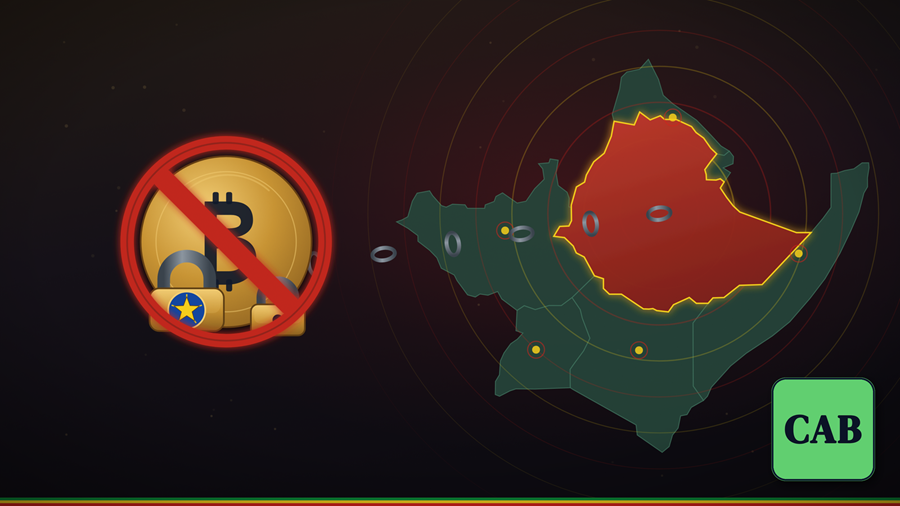
On July 23, 2026, the National Bank of Ethiopia (NBE) issued a public notice clarifying and expanding prohibitions on virtual assets within the country. Moving beyond its prior warnings on retail cryptocurrencies and Birr-paired peer-to-peer (P2P) trading, the NBE’s updated directive explicitly covers all digital representations of value.
The notice prohibits trading, fiat-to-crypto exchanges, asset-to-asset swaps, transfers, custody/safekeeping, and the provision of ancillary financial services related to virtual asset issuance unless explicitly authorized by the central bank.
While the NBE frames this directive around foreign exchange (FX) preservation, consumer protection, and financial crime risk management, the decision highlights a growing policy divergence within East Africa and across the broader continent.
This brief evaluates the drivers of the NBE’s stance, compares Ethiopia’s posture with regional peers, and provides strategic recommendations for governments, regulators, and financial operators.
Breakdown of the NBE 23 July 2026 Public Notice
The NBE’s latest stance represents an evolution from targeted trade warnings to a broad restriction covering the virtual asset service provider (VASP) value chain:
Prohibited Activities
- Fiat/Crypto Swaps
- Virtual Asset Swaps
- Asset Custody & Holding
- Financial Services
Regulatory Scope Extension
- Beyond Bitcoin & Crypto
- All Digital Value Reps
- Token Offerings & Sales
- P2P & Wallet Operators
Key Scope Additions
- Definition Expansion: Rather than solely targeting prominent cryptocurrencies like bitcoin, the notice applies to “digital representations of value that can be electronically traded, transferred, exchanged, or used for payment or investment”.
- Targeting Institutional Infrastructure: The prohibition explicitly covers custody, safekeeping, and administration. This legally restricts centralized exchanges, wallet providers, and fintechs from maintaining custody instruments or offering digital asset infrastructure in Ethiopia.
- Ancillary Financial Services: Commercial banks, payment gateways, and financial intermediaries are prohibited from facilitating the issuance, underwriting, settlement, or sale of virtual assets.
The Ethiopian Policy Dynamic: State-Supported Mining Amidst Domestic Financial Restrictions
A notable dynamic in Ethiopia’s digital asset landscape is the structural separation between monetary regulation and industrial development:
- Monetary & Payment Ban (NBE): The central bank restricts domestic virtual asset trading, transfer, and settlement to protect the Ethiopian Birr, prevent foreign exchange leakage, and mitigate financial crime risks.
- Industrial Power Utilization (EEP / INSA): Concurrently, state entities such as Ethiopian Electric Power (EEP) and the Information Network Security Administration (INSA) have established frameworks permitting state-registered industrial Bitcoin mining operations to monetize excess hydro-electric power from the Grand Ethiopian Renaissance Dam (GERD) for foreign currency revenues.
Policy Insight: Ethiopia’s current posture reflects an industrial infrastructure approach. While foreign data centers and state-monitored miners leverage domestic power capacity, domestic consumers and commercial enterprises remain prohibited from holding, settling, or trading in digital assets.
Comparative Analysis Across Relevant Jurisdictions
Comparing Ethiopia’s strategy against regional peers and global approaches reveals distinct approaches to digital asset governance:
| Regulatory Parameter | Ethiopia (NBE Notice 2026) | Kenya (VASP Regulations 2026) | South Africa (FSCA Framework) | Global Parallel: China Model |
| Primary Policy Stance | Strict Restrictions / Prohibition (unless expressly authorized). | Full Licensing & Statutory Oversight. | Financial Product Licensing & AML Compliance. | Domestic Trade Ban paired with state-controlled tech/mining oversight. |
| Targeted Entities | Exchanges, custody platforms, P2P brokers, financial facilitators. | Exchanges, wallet custodians, stablecoin issuers, P2P platforms. | Crypto Asset Service Providers (CASPs), financial advisors. | Offshore exchanges, domestic fiat gateways, non-registered mining operations. |
| Primary Risk Driver | Foreign exchange preservation, Birr stabilization, fraud prevention. | Market integrity, consumer protection, revenue capture, financial inclusion. | Market conduct, FATF compliance, institutional integration. | Capital controls, monetary sovereignty, energy grid protection. |
| Impact on Shadow Markets | Risk of pushing retail trades into unmonitored P2P and messaging channels. | Incentivizes operators to transition into formal regulatory rails. | Integrates CASPs into formal financial intelligence reporting (FIC). | Drives adoption of decentralized exchanges and offshore P2P channels. |
1. The Regional Policy Divide: Pro-Integration and Regulated vs. Protectionist and Restrictive
The regulatory split in East Africa—where Kenya and Rwanda establish formal licensing regimes while Ethiopia doubles down on prohibition—creates a serious policy divide across the region. This divergence fundamentally alters cross-border trade, capital allocation, and financial surveillance across the East African Community (EAC) and the Horn of Africa.
East Africa, splitted into two distinct governance camps, is shown below:
| Pro-Integration & Regulated (Kenya & Rwanda) | Protectionist & Restrictive (Ethiopia) |
| Formal VASP Licensing & Oversight | Comprehensive Transaction Ban |
| Stablecoin Settlement Rails | Strict Capital & FX Controls |
| FATF Recommendation 15 Compliance | P2P Submerged into Shadow Markets |
| Regional Fintech Hub Strategy | Dual Policy: State Mining vs. Retail Ban |
- The EAC Regulatory Sandbox (Kenya & Rwanda): Kenya’s VASP Regulations and Rwanda’s progressive fintech policies treat digital assets as legitimate economic infrastructure. Their focus is on bringing virtual asset service providers (VASPs) into formal banking, collecting transactional taxes, enforcing the FATF Travel Rule, and establishing Nairobi and Kigali as regional gateways for global fintech capital.
- The Horn of Africa Monetary Fortress (Ethiopia): The National Bank of Ethiopia (NBE) prioritizes foreign exchange preservation, Birr stabilization, and strict capital controls. By banning domestic trading, custody, and transfers, Ethiopia treats digital assets primarily as a threat to monetary sovereignty and FX reserves.
2. Regulatory Arbitrage, Capital Flight, and Talent Clustering
When neighboring countries enact opposing rules on mobile-first technologies, capital and talent flow toward the path of least-resistance jurisdictions.
- Regional Headquarters Migration
African and international web3 startups targeting the East African market will increasingly incorporate in Nairobi or Kigali to secure valid licenses, bank accounts, and legal protections. Ethiopian tech talent and founders face structural incentives to re-domicile or establish holding companies in Kenya or Rwanda while serving regional user bases remotely.
- Arbitrage in Capital Raising
Regulated VASPs in Kenya and Rwanda can raise institutional venture capital, issue audited stablecoins, and partner with regional commercial banks. Ethiopian operators remain excluded from formal capital markets, forcing local platforms into informal funding channels or offshore shell structures.
3. P2P Spillover and Shadow Liquidity Corridors
Prohibiting virtual assets in Ethiopia does not extinguish retail demand—it displaces it into cross-border shadow rails that rely on Kenyan and Rwandan banking infrastructure.
- Cross-Border Liquidity Bridges: Cross-Border Liquidity Bridges: To hedge against domestic inflation and access USD liquidity, Ethiopian users routinely leverage peer-to-peer (P2P) and over-the-counter (OTC) desks in regional hubs like Nairobi and Kigali. Traders settle these transactions via Kenyan Shilling (KES) or Rwandan Franc (RWF) mobile money and banking channels before converting the funds into stablecoins—effectively routing capital out of a restricted domestic market and through licensed payment rails in neighboring jurisdictions.
- Compliance Headaches for Neighboring FIUs: This cross-border spillover complicates anti-money laundering (AML) efforts for regulators in Kenya and Rwanda. Financial Intelligence Units (FIUs) in Nairobi and Kigali must monitor whether local accounts are being used as illicit clearinghouses for unauthorized FX flight originating from Ethiopia.
4. Friction in Intra-Regional Trade and AfCFTA Alignment
The contrast in digital asset rules creates operational friction for regional payment systems and cross-border commercial trade:
- Imbalance in Cross-Border Remittances: Kenya and Rwanda are positioning themselves to leverage stablecoins to reduce remittance costs across regional corridors. Ethiopia’s prohibition cuts its domestic economy off from these low-cost digital payment rails, forcing citizens and cross-border traders to rely on expensive correspondent banking networks or informal hawala channels.
- Undermining EAC Payment Harmonization: The East African Community’s broader objective of building an integrated, real-time regional payment network (under the EAC Cross-Border Payment System Masterplan) becomes harder to achieve when a major regional economy bans the technology rails that neighboring states are actively formalizing.
5. FATF Grey-Listing Risks and Financial Integrity
The policy divergence directly affects how international oversight bodies evaluate regional financial risk:
- Kenya’s Compliance Drive: By formalizing its VASP framework and enforcing FATF Recommendation 15, Kenya aims to demonstrate strong regulatory oversight and exit international grey-lists, boosting its credibility with international financial institutions.
- Ethiopia’s Shadow Market Exposure: By driving virtual asset transactions into unmonitored messaging groups and informal OTC desks, Ethiopia paradoxically increases its vulnerability to financial crime. Unregulated shadow markets reduce visibility for national intelligence units and raise concerns during FATF mutual evaluations.
Regulatory Intelligence: Key Lessons for African Jurisdictions
1. The Risk of Informal Market Migration
Experience across African markets shows that broad restrictions on fiat gateways rarely eliminate underlying demand. Instead, retail activity often migrates toward decentralized messaging platforms (e.g., Telegram or WhatsApp trading groups) and informal OTC networks. This shift can reduce visibility for Financial Intelligence Units (FIUs) and make AML/CFT surveillance more challenging.
2. Regional Integration & Trade Challenges
As neighboring East African Community (EAC) member states (e.g., Kenya and Rwanda) introduce formal VASP licensing regimes to support cross-border settlements and fintech innovation, divergent restrictions can introduce operational friction for regional payment channels and cross-border commercial transactions.
3. Clear Regulatory Guidance devoid of Ambiguity
By publishing explicit notices detailing prohibited activities—such as custody, transfers, and asset swaps—the NBE provides clear legal boundaries regarding its current supervisory expectations. Clear guidance helps commercial banks and market participants ensure compliance with central bank directives.
Actionable Recommendations for Stakeholders
For Governments, Policymakers & Central Banks
- Establish an EAC-IGAD Joint Working Group: Regulatory bodies across the EAC and the Intergovernmental Authority on Development (IGAD) should establish a joint taskforce to share transaction intelligence and harmonize cross-border VASP definitions.
- Standardize Travel Rule Data Sharing: Regulators in Kenya and Rwanda should mandate that licensed VASPs implement strict origin/beneficiary tracking on all cross-border transfers involving non-cooperative or restricted neighboring jurisdictions.
- Transition to Risk-Proportional Oversight: Ethiopian authorities should consider utilizing regulatory sandboxes or controlled pilot programs for cross-border remittances—allowing the state to capture supervisory visibility and tax revenues without sacrificing monetary stability.
- Evaluate FX Risk vs. Market Visibility: Balance monetary and FX controls with the need to retain supervisory visibility over digital payment flows.
- Coordinate Multi-Agency Policies: Ensure alignment between energy/industrial regulators, security agencies, and monetary authorities to establish consistent legal frameworks.
- Enhance FIU Monitoring Capabilities: Invest in blockchain analytics and transaction-monitoring tools to track informal P2P networks operating outside regulated banking channels.
For Commercial Banks & Financial Institutions
- Strengthen Transaction Screening: Implement transaction-monitoring protocols to detect unauthorized fiat transfers linked to unregulated virtual asset trading platforms.
- Maintain Clear Compliance Audits: Ensure internal procedures align directly with the NBE’s public directives regarding virtual asset facilitation.
For Virtual Asset Operators (VASPs)
- Implement Jurisdictional Controls: International operators should apply IP geofencing and compliance checks to prevent unauthorized user onboarding in restricted jurisdictions.
- Engage in Regulatory Dialogues: Explore formal consultations where available to offer possible support for monetary policy and financial stability and demonstrate compliant, bank-supervised use cases.
East Africa must work together to close the gaps, on all fronts, so Ethiopia does not become (or remain) one of the weakest links in the region’s regulatory chain in the virtual asset sector and digital asset economy.
Discover more from CAB
Subscribe to get the latest posts sent to your email.