Edward Aziegbe, Reporter
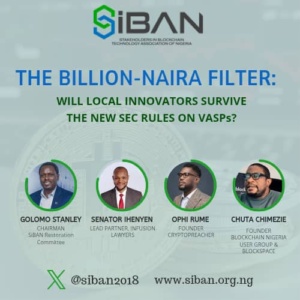
The X Space discussion titled “The Billion Naira Filter: Will Local Innovators Survive the New SEC Rules on VASPs?” was held 16 January 2026, courtesy of the Stanley Golomo-led Restoration Committee of the Stakeholders in Blockchain Technology Association of Nigeria (SiBAN). This X Space was effectively an emergency industry dialogue regarding the Securities and Exchange Commission (SEC) Nigeria’s Circular No. 26-1, “Revised Minimum Capital (MC) for Regulated Capital Market Entities.
The discussion brought together stakeholders from industry leaders to legal experts and market analysts to dissect the immediate implications of the SEC’s revised minimum capital requirements.
CAB’s Man Around Town, a participant at the X Space, reports.
SEC Nigeria’s Sweeping Capital Hikes across the Capital Market: VASPs Implicated
Within hours of the Securities and Exchange Commission (SEC) releasing its Circular No. 26-1, an emergency X Space convened some of Nigeria’s leading voices in Nigeria’s emerging virtual asset industry. The consensus among the listeners was clear: while the SEC aims for “market resilience,” the sheer scale of the capital increases threaten to fundamentally reshape the Nigerian digital economy into an “exclusive club” for institutional giants.
The primary point of contention focused on the minimum capital requirements of the various categories of Virtual Asset Service Providers (VASP), both old and new, which have been set to as high as a staggering N2 billion.
Anchored by Stanley Golomo who chairs SiBAN’s interim leadership pending its next elections, the industry dialogue was well attended, hitting over 380 participants.
What does the SEC Circular really change?
Senator Ihenyen, Lead Partner at Infusion Lawyers, responding to a question requiring him to reveal the new capital requirements for Virtual Asset Service Providers (VASPs) in Nigeria, broke down the regulatory demand. Ihenyen highlighted that Digital Assets Offering Platforms (DAOP) and Real-world Assets Tokenization and Offering Platforms (RATOP) are expected to meet a higher threshold of ₦1 billion. Digital Assets Intermediaries (DAI) and Digital Assets Platform Operators (DAPO) require ₦500 million, while Digital Assets Exchanges (DAX) and Digital Assets Custodians must have a substantial ₦2 billion. For Ancillary Virtual Assets Service Providers (AVASPs), they would need ₦300 million in capital.
Ihenyen pointed out the significant jump in requirements, contrasting with the 2022 figures and the proposed 2024 amendment. Notably, DAX moved from ₦500 million in 2022 to a proposed ₦1 billion in 2024, and now doubles to ₦2 billion. The same applies to Digital Assets Custodians (DAC), reflecting a substantial increase in regulatory expectations for these entities. He observed that the SEC’s doubling down on minimum share capital suggests the regulator is insistent on beefing up capital reserves for VASPs, despite industry concerns. He noted that this move indicates the SEC is pushing for significant capital increases without considering the nascent nature of the virtual assets market, which is yet to develop locally.
Ihenyen, the Executive Chair of the Steering Committee of the Africa-focused advocacy group, the Virtual Asset Service Providers Association (VASPA) cautions that the new capital requirements for VASPs may stifle innovation in Nigeria’s emerging industry, arguing that the SEC should prioritize support over stringent demands. He believes that when you hike capital requirements in such a young industry, you’ll stifle innovation until it can’t breathe. Ihenyen recommends a gradual, risk-based, and tiered approach, leveraging data and collaboration to balance market development and protection, benefiting local innovators and Nigeria’s global competitiveness. He urges stakeholders to engage with the SEC before enforcement begins, and tasks Nigeria to improve the rule of law and the business environment where players will have a conducive and enabling environment to build, grow, and expand.
What’s the SEC’s intention, and did it miss it?
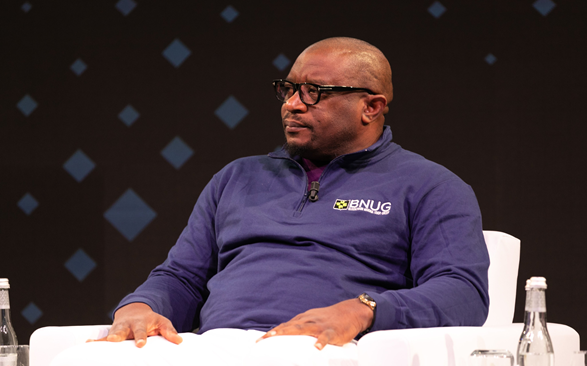
“To protect the capital market”, said Chimezie Chuta, Founder of Blockchain Nigeria User Group (BNUG) and Vice Chairman of the Blockchain Industry Coordinating Committee of Nigeria (BICCoN), responding to a question bordering on what the intention of the SEC really is considering its approach to the new capital requirements.
Speaking on the sidelines of a discussion, Chuta expressed that he wasn’t so surprised by the development, citing the undeniable influence of political interests on policy and regulatory decisions. He welcomed the SEC’s recognition and regulation of the virtual assets industry but expressed reservations about the mindset behind the high capital requirements.
“Do not use regulation to stifle innovation and growth. And this regulation will do exactly that,” Chuta quipped, doubting the presence of substantial funds in Nigeria’s nascent crypto industry. He attributed the country’s seeming high volumes to millions of young retail users with small daily transactions, rather than institutional capital.
Chuta fears that the stringent requirements may drive innovators away, ultimately hurting Nigeria’s competitiveness in the emerging industry. “I feel pain as an industry leader who has been on this journey for a long time and has even worked with the current [SEC] chair,” he said, urging for realignment and renewed consultations. “We need to find a way to align properly,” and “see how we can get [the SEC] back to the consultation table,” he added.
Is regulation really all about government revenue, not enabling and safeguarding innovation?
Rume Ophi, a leading crypto market analyst and the founder of Cryptopreacher Academy, expressed his take on the SEC’s minimum capital hike in the virtual assets industry. Rume Ophi, a leading crypto market analyst and founder of Cryptopreacher Academy, blasts the regulator’s approach, saying the message is clear: “If you don’t have the money, go and die.”
Ophi expresses disappointment, stating that the administration’s promise to work with industry players has apparently been reduced to a revenue business. “This is not a way to run a country,” he says, noting that the younger generation is unaware of the implications.
Using an analogy, Ophi likens the SEC’s approach to a landlord prioritizing rent collection without maintaining the property. He discourages industry patronage of regulators with misaligned interests, pointing to South Africa and Ghana as countries moving forward.
Ophi urges industry operators to speak out, believing that silence will embolden the SEC. “There should be spaces going on calling out the SEC to do the right thing. We need to keep on talking. If we keep quiet, it will become law,” he emphasizes. He adds, “The people have a problem, and the government also has a problem. This industry is supposed to be for people that can think … the future is at risk.”
Read also: Nigeria’s SEC Engages VASPs, Says It’s Making Steady Progress with Licensing Process
Highpoints and Pain points from the Dialogue
Particularly “Prohibitive” for Indigenous Startups
Generally, the speakers and some of the members of the audience who also took the mic argued that the requirements are particularly “prohibitive” for indigenous startups. They commonly noted that the new minimum capital requirements could stifle the very innovators that the SEC should be comprehensively supporting to grow the nascent industry leveraging the SEC’s regulatory tools for market developments and economic expansion.
Speakers expressed concern that this move signals a “top-down” regulatory approach that favors traditional conglomerates over the agile fintech ecosystem that has put Nigeria on the global map.
The “Market Resilience Defense” vs. “Lazy Capital”
In introducing the new capital requirements for market operators, the SEC states that it is aimed at boosting resilience in the capital market, enhancing consumer and investor protection. Though the dialogue considers the proactiveness of the SEC towards ensuring that operators strengthen their financial capabilities to support market growth, they strongly believe that the significant increase in minimum capital requirements will seriously disrupt some operators.
They contended that requiring an innovator to lock up N2 billion just to hold a license is an inefficient use of capital that could otherwise be used for cybersecurity, product scaling, and talent acquisition. It’s “lazy capital”.
Industry Exclusion and the Absence of Consultation
A recurring theme throughout the over four-hour townhall discussion was the lack of industry participation in the recent hike.
“Regulation should be a dialogue, not a decree,” one speaker noted. They hope regulators don;t lose goodwill.
The conversation highlighted that many VASPs are currently in “licensing limbo,” and these new capital floors may force them to pivot their headquarters to more “fintech-friendly” jurisdictions like South Africa or Mauritius, leading to capital and talent flight.
Silence of the Graveyard by Founders/CEOS/Managers—the Fear of Potential Victimization
Notably, founders and CEOs of virtual asset platforms in Nigeria often remain silent on industry issues, despite being impacted by regulatory challenges, observed one of the guest speakers.
Responding to the observation above, a VASP founder in the audience shared his distressing experience of being targeted by authorities after speaking out, highlighting the fear of victimization that silences many leaders. Earlier, Rume Ophi had encouraged industry operators to speak out more, but this founder’s experience underscores the risks involved. Others questioned how to address this challenge, given Nigeria’s weak rule of law.
The Proposed Path Forward
The first SiBAN X Space for the year concluded with a call for a truly “risk-based” and “adaptive” approach that encourages tiered growth. The proposed solutions discussed included:
- The SEC should introduce tiered licensing categories with lower capital requirements, allowing smaller operators to thrive.
- To reflect current market conditions, the SEC should review the new minimum capital requirements downwards—and significantly too.
- Beyond capital requirements, the SEC should use its regulatory power to negotiate tax breaks and incentives for the emerging virtual asset industry.
- VASPs and industry stakeholders must reorganize and engage more effectively with regulators, policymakers, and the government.
- The SEC should work with the CBN and other authorities to create a one-stop platform for VASPs to register and obtain licenses in Nigeria.
- VASPs and other relevant stakeholders should work together and ensure that they reach out to the SEC to help address the concerns that have been raised. SiBAN plans to take this initiative.
- The virtual asset industry should explore concrete ways to safeguard its interests, beyond mere consultations that often yield little result. This could involve building alliances, advocating for supportive policies, or seeking legal recourse when necessary.
Closing
The X Space serves as a loud alarm to the Commission: without a recalibration of these requirements, the SEC risks “protecting” a market that may no longer have innovators—particularly local innovators—to populate it.
As Nigeria’s virtual asset industry navigates these regulatory shifts, stakeholders must unite to shape a conducive environment. By advocating for balanced policies, exploring innovative solutions, and engaging constructively with regulators, the industry can unlock its vast potential, drive economic growth, and cement Nigeria’s position in the global digital economy. The path forward requires collaboration, resilience, and a shared vision for a thriving, regulated virtual asset ecosystem in Nigeria.
Read also: SEC Nigeria Raises Minimum Capital for Market Operators, including VASPs as Industry Reacts.
Discover more from Crypto Asset Buyer
Subscribe to get the latest posts sent to your email.